Top Drive-in Storage Solutions for Global Buyers?
Drive-in Storage helps businesses store large quantities of identical pallets within a compact footprint. It suits cold rooms, beverage warehouses, food distribution centers, and seasonal inventory. Unlike selective racking, this system reduces aisle space and increases storage density. The trade-off is equally clear: access follows a last-in, first-out pattern. Buyers must understand that limitation before comparing suppliers.
Gwynne Richards, a recognized warehouse management author and logistics expert, states, “Warehouse design must support the overall supply chain strategy.” This principle matters when evaluating Drive-in Storage across different markets. A suitable solution should match pallet dimensions, forklift type, load weight, ceiling height, and turnover rate. It should also include clear frame protection, reliable rails, and corrosion-resistant finishes where humidity is high. Small details matter. A damaged guide rail can interrupt an entire storage lane.
Global buyers should request load calculations, installation drawings, warranty terms, and maintenance guidance. Supplier experience also deserves careful review. Ask for references from warehouses with similar products and operating conditions. Some systems look efficient on paper but perform poorly under careless forklift operation. That reality is easy to overlook.
There is no universal best option. A high-density layout may reduce construction costs, yet it can increase handling time. A stronger specification may cost more initially, but it can improve safety and service life. Buyers should compare total operating value, not only the purchase price. Even experienced teams can misjudge future product changes. Flexible planning remains wise.
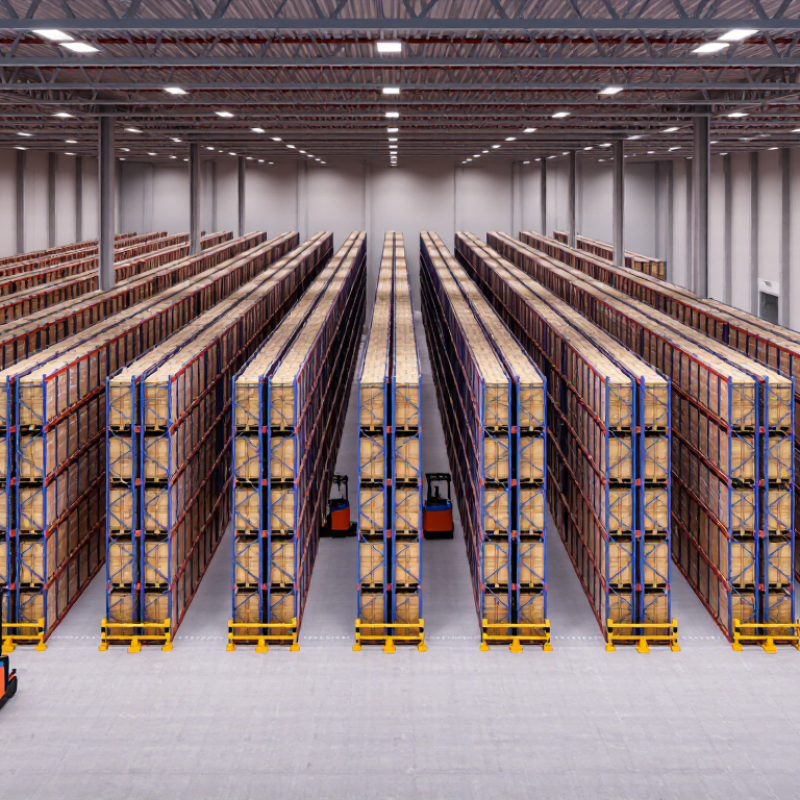
What Is Drive-In Storage and How Does It Work?
Drive-in storage is a high-density pallet racking system designed for limited-SKU inventory. Steel rails support pallets inside deep storage lanes. A forklift enters the lane, places pallets from the back forward, then retrieves them in reverse order. This creates last-in, first-out (LIFO) movement. It suits seasonal goods, uniform cartons, and products stored in large batches.
Unlike selective racking, drive-in storage removes many access aisles. The result can be substantially higher floor utilization, although exact gains depend on pallet dimensions, building height, and operating rules. The 2024 Annual Industry Report from the Material Handling Industry reports that 55% of respondents expect increased technology investment. Dense storage can support that goal, but it does not replace careful process design.
Daily work is quite physical. A driver checks the rail, enters slowly, and keeps the load centered above both supports. Damaged rails, uneven pallets, or poor visibility can create serious handling risks. The 2024 State of Logistics Report places United States business logistics costs at about 2.3 trillion dollars, equal to 8.7% of GDP. Small storage inefficiencies matter. Still, drive-in is not ideal for fast-moving products requiring FIFO access. That trade-off is easy to underestimate. A detailed traffic study, load calculation, fire-protection review, and operator training should come before installation. My practical view is simple: density helps only when the warehouse can use it consistently.
Drive-in storage systems are designed for high-density pallet holding, especially where many pallets share the same stock-keeping unit. Their key feature is deep-lane storage, allowing forklifts to enter the rack instead of stopping at its face. The trade-off is important: drive-in layouts usually support last-in, first-out rotation, not strict first-in, first-out control.
MHI’s 2024 Annual Industry Report found that 83% of supply chain leaders expected to increase technology investment within two years. That pressure makes accurate rack design more valuable. A reliable system should include adjustable entry guides, strong pallet rails, rear stops, and visible load-capacity labels. Upright guards matter too. One careless forklift impact can damage more than one bay.
Forklift compatibility deserves careful testing. Check mast height, turning clearance, pallet dimensions, and lane depth before approval.
The Occupational Safety and Health Administration requires stored materials to remain stable and secure, while ANSI MH16.1 addresses rack loads, impact, and structural design. These are not decorative references. They shape daily safety decisions.
Temperature-controlled warehouses may need corrosion-resistant finishes and wider clearances for protective clothing. Fire protection can also change with storage height and commodity type. The FM Global Property Loss Prevention Data Sheets warn that storage arrangement affects sprinkler performance. That detail is easy to overlook.
Deep lanes save floor space, but they can slow selection. That weakness should be admitted. A thoughtful buyer compares density gains against rotation speed, inspection access, and operator training before choosing the final configuration.
Drive-in storage works best when warehouses hold many pallets of the same product. It can provide higher density than selective racking, but access becomes less flexible. Compare usable pallet positions, not the supplier’s headline capacity. Check tunnel depth, entry width, beam loading, and forklift clearance with real pallet dimensions.
Global buyers should match the rack design to operating conditions. A cold warehouse needs suitable coatings and impact protection. A seismic region may require engineered anchoring and local approval. Ask for load calculations, inspection procedures, replacement-part availability, and installation support.
MHI’s 2024 Annual Industry Report found that 55% of supply chain leaders planned to increase technology investment.
That supports better monitoring, but sensors cannot fix poor slotting. WERC’s 2024 DC Measures report places inventory accuracy near a 99.5% median benchmark. A drive-in layout may challenge that target when pallets hide behind older stock. This is often overlooked.
Tips: Compare LIFO and FIFO requirements before requesting prices. Test forklift turning space with a taped floor layout. Measure retrieval time during peak shifts. Request references from warehouses with similar pallet weights and climates. Also calculate the cost of lost selectivity. A lower purchase price may create slower picking, damaged pallets, or difficult inspections. The comparison is not perfectly universal; local codes, labor habits, and maintenance skills can change the result.
Drive-in storage can increase pallet density, but installation quality determines whether the system performs safely. Before delivery, measure clear height, aisle width, floor flatness, and sprinkler locations. A practical site survey should include forklift turning paths and emergency access. Small measurement errors can become expensive corrections.
Anchor frames according to engineering drawings and local structural requirements. Check upright alignment after each bay is assembled. Never assume an existing concrete slab can support concentrated loads without verification. A qualified engineer should review slab strength, anchoring, seismic exposure, and expected pallet weight. Safety depends on disciplined loading, not appearance. Use forklifts with suitable mast height and reach. Operators need training for guided entry and reverse exit. Add load signs, rack protectors, and visible aisle markings. Inspect beams, frames, anchors, and guide rails regularly. Damaged components require isolation until assessed. We have seen rushed installations pass visual checks, then reveal uneven loading weeks later.
Tips: Confirm pallet dimensions before selecting bay depth. Keep heavier loads in lower positions. Leave clearances around sprinklers and lighting. Test the first bay with a controlled load. Record every inspection. Do not rely on memory. Recheck compatibility when changing pallets, forklifts, or warehouse processes.
| Solution Configuration | Best-Fit Inventory | Pallet Access Method | Typical Storage Density | Installation Considerations | Key Safety Requirements | Warehouse Compatibility | Operational Limitations |
|---|---|---|---|---|---|---|---|
| Single-Entry Drive-in Rack | Large quantities of the same SKU; non-perishable or long-dwell goods | LIFO; forklift enters and loads from one side | High; commonly around 60–85% more pallet positions than selective rack in suitable layouts | Requires a level, properly rated floor; upright frames, guide rails, load beams, and back protection must be aligned and anchored according to the engineering design | Use rack-compatible forklifts, controlled travel speed, impact protection, load notices, regular inspections, and clearly marked entry lanes | Best for warehouses with high storage depth, limited SKU variety, and adequate forklift maneuvering space | Limited selectivity; older pallets or mixed batches may remain inaccessible behind front pallets |
| Double-Entry Drive-through Rack | High-volume goods requiring loading from one side and unloading from the other | FIFO is possible when loading and unloading are managed from opposite aisles | High, but usually lower than single-entry drive-in because both ends require access aisles | Needs two clear operating aisles and accurate alignment between front and rear access points; building columns and fire routes must be checked before installation | Separate loading and unloading traffic where possible, protect both rack ends, maintain visibility, and prevent pedestrians from entering forklift channels | Suitable for through-flow layouts, temperature-controlled storage, and operations with defined replenishment and dispatch sides | Higher space requirement than single-entry designs; FIFO depends on disciplined stock rotation |
| Deep-Lane Drive-in Rack | Seasonal products, reserve inventory, beverages, packaged food, and uniform pallet loads | Usually LIFO; multiple pallets are stored in lanes several positions deep | Very high where SKU concentration is high and aisle reduction is valuable | Lane depth, pallet overhang, guide-rail position, and forklift dimensions must be coordinated before fabrication; floor flatness is particularly important | Install pallet stops or back protection where required, use appropriate entry guidance, and prohibit climbing or walking inside storage lanes | Works well in buildings with high clear height and low-to-medium SKU counts; requires consistent pallet dimensions | Not ideal for frequent SKU changes, irregular pallets, or products with short shelf life |
| Pallet Shuttle Drive-in Lane | High-throughput, high-density storage with repetitive pallet movements and multiple temperature zones | Remote shuttle moves pallets within deep lanes; LIFO or FIFO can be configured by lane design | Very high; reduces forklift travel inside lanes and can support substantially deeper storage than standard drive-in operation | Requires charging arrangements, rail alignment, control integration, compatible pallets, and commissioning tests; floor levelness and temperature conditions must be verified | Use lane-entry sensors, anti-drop devices, emergency stops, access controls, battery procedures, and trained operators; never enter an active lane | Suitable for cold stores, high-bay warehouses, and facilities seeking to reduce forklift traffic inside rack lanes | Higher capital cost and greater dependence on battery maintenance, controls, and technical support |
| Drive-in Rack for Cold Storage | Frozen food, chilled goods, and temperature-sensitive products stored on standardized pallets | LIFO for standard drive-in; FIFO when configured as drive-through or combined with shuttle handling | High, helping reduce the volume of refrigerated or frozen building space per pallet | Use corrosion-resistant finishes where needed; verify freezer floor joints, insulation clearances, door locations, evaporator airflow, and defrost conditions | Specify cold-rated equipment, anti-slip surfaces, visibility aids, restricted pedestrian access, and procedures for condensation and ice control | Best for high-volume, low-SKU cold rooms with uniform pallet footprints and stable load weights | Cold conditions can affect batteries, lubricants, plastics, sensors, and worker productivity; maintenance access must be planned |
| Mixed-Depth Drive-in Zone | Facilities handling several product families with different demand rates and storage depths | LIFO or FIFO according to the selected lane arrangement and operating policy | Medium to high; uses shallow lanes for faster-moving items and deeper lanes for reserve stock | Requires detailed SKU analysis, pallet-load mapping, rack bay design, and clear separation of lane depths during installation | Mark each lane clearly, display load capacities, protect transitions between different depths, and audit actual pallet weights | Useful where a single storage depth would create excessive travel or poor space utilization | More complex to plan and operate; incorrect lane assignment can reduce accessibility and inventory accuracy |
Global buyers should treat drive-in racking as a warehouse engineering project, not a simple price purchase. The 2023 World Bank Logistics Performance Index covered 139 economies and highlighted major differences in infrastructure, customs, and delivery reliability. These differences affect steel lead times, spare-part access, and installation support. A supplier should provide load calculations, pallet dimensions, entry clearances, and corrosion protection details. Ask for production drawings before approving customization. Small errors become expensive when aisles are already built.
Customization should match local operations. Confirm pallet weight, forklift type, rack depth, tunnel length, temperature, and seismic conditions. Request material certificates, weld inspection records, coating specifications, and independent load testing. The MHI 2024 Annual Industry Report continues to identify labor pressure and technology adoption as major supply-chain concerns. Therefore, buyers should evaluate service responsiveness, installation training, and inspection procedures, not only storage density. A dense system is not automatically efficient.
Tips: Compare at least three suppliers using one technical specification. Score quality, lead time, documentation, warranty, and after-sales support separately. Ask for two comparable project references. Check whether replacement components are locally available. A low quote can hide weak engineering. I would also leave room for uncertainty; supplier claims and actual site conditions sometimes differ. A pre-shipment inspection is useful, but it cannot replace a careful warehouse survey.
It is a dense pallet-racking system with steel rails inside deep lanes. Forklifts enter the lanes to place and retrieve pallets.
The forklift places pallets from the back toward the entrance. Retrieval usually follows the reverse order, creating last-in, first-out movement.
It suits seasonal goods, uniform cartons, and large batches with limited product variety. Identical pallets work well.
It removes many access aisles and can improve floor utilization. Actual gains depend on pallet size, building height, and operating rules.
It may not suit fast-moving products requiring first-in, first-out access. Hidden older pallets can also make stock rotation difficult.
Compare usable pallet positions, tunnel depth, entry width, beam capacity, and forklift clearance. Use real pallet measurements, not advertised capacity alone.
Operators should enter slowly and keep loads centered on both rails. Damaged rails, uneven pallets, and poor visibility can cause serious handling risks.
Request load calculations, production drawings, material records, coating details, and inspection procedures. Check replacement parts and installation support locally.
Mark the floor with tape and test forklift turning space. Measure retrieval time during busy shifts. Small tests reveal uncomfortable truths.
No. Lower pricing may hide weak engineering, slow picking, damaged pallets, or difficult inspections. I may still underestimate site-specific costs.
Drive-in Storage is a high-density warehouse solution designed to maximize floor space by allowing forklifts to enter storage lanes and place pallets on supported rails. Unlike conventional selective racking, it reduces the need for multiple aisles, making it especially suitable for large quantities of similar products with relatively low turnover. A well-designed system should provide stable frames, durable rails, clear load capacities, suitable entry depths, and practical access for loading and unloading.
For global buyers, comparing Drive-in Storage solutions requires more than reviewing price. Buyers should assess pallet dimensions, forklift type, warehouse height, floor conditions, operating methods, fire protection, and safety requirements. Installation planning must include anchoring, aisle clearance, inspection access, and compatibility with existing warehouse equipment. During sourcing, clear technical drawings, customization capability, quality control, packaging, delivery arrangements, installation support, warranties, and supplier communication are essential evaluation criteria. Selecting a solution that balances density, safety, flexibility, and long-term service can improve storage efficiency across different warehouse environments.

Kimsuk Rack